Tandem Compute is developing a distributed network of fibre-connected, liquid-cooled compute pods across Ireland, and is raising investment under EIIS, the Employment Investment Incentive Scheme, with income tax relief for qualifying investors. Electricity powers the compute; useful heat is designed to be returned to host sites. Register to receive the Information Memorandum.
compute. heat. return.
eiis raise€5.5m
minimum term4 years
eiis relief50%
stagepre-trading
Terms indicative and subject to the Information Memorandum and subscription documents.
register interest
Request the Information Memorandum.
Investor type
Indicative amount you may consider
Expression of interest only — non-binding. To invest, apply through the shareholder application page. By submitting, you ask Tandem Compute Ltd to manage this registration and email you the Information Memorandum. Privacy Notice
register interest
tandem compute ltd · investor registration
Invest in Irish AI compute through EIIS.
Tandem Compute is developing a distributed network of fibre-connected, liquid-cooled compute pods across Ireland, and is raising investment under EIIS, the Employment Investment Incentive Scheme, with income tax relief for qualifying investors. Electricity powers the compute; useful heat is designed to be returned to host sites. Register to receive the Information Memorandum.
compute. heat. return.
draft — wording pending adviser approval
The new A Ordinary Shares are held for EIIS investors by the nominee Redquartz Trustees Ventures Limited (CRO 670489). tandemcompute is a qualifying pre-trading company raising under EIIS; subscriptions carry 50% income-tax relief, subject to each investor satisfying the individual investor conditions.
eiis raise€5.5m
minimum term4 years
eiis relief50%
stagepre-trading
Terms indicative and subject to the Information Memorandum and subscription documents.
register interest
Request the Information Memorandum.
{{ firstErr }}
{{ surnameErr }}
{{ emailErr }}
{{ phoneErr }}
Investor type
Indicative amount you may consider
{{ rangeErr }}
{{ submitError }}
{{ submitLabel }}
Expression of interest only — non-binding. To invest, apply through the shareholder application page. By submitting, you ask Tandem Compute Ltd to manage this registration and email you the Information Memorandum. Privacy Notice
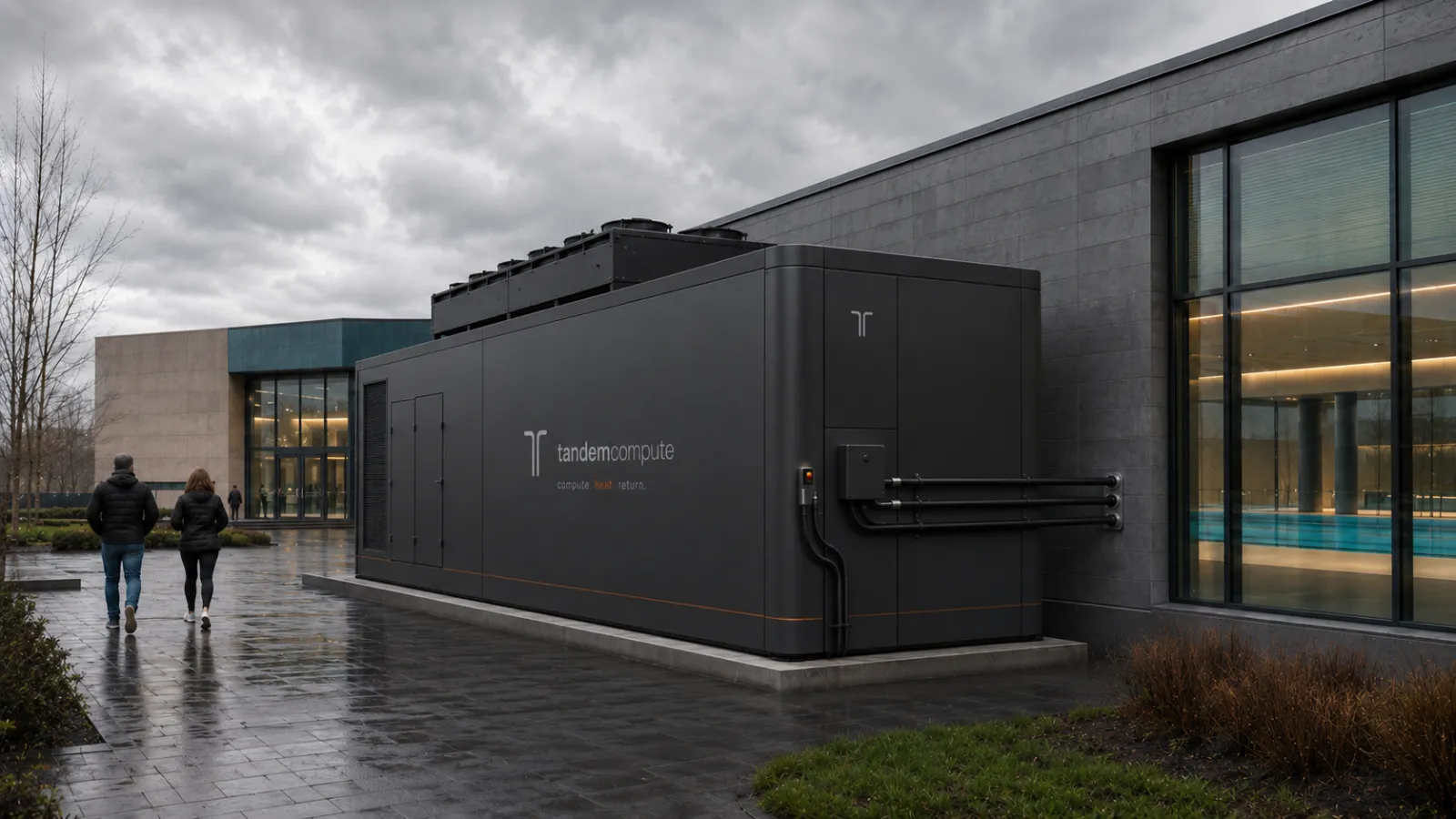
concept visual · 200 kVA pod200 kVA external unit shown — pods can also sit in an internal plant room. Final design subject to engineering, planning, procurement and host agreement. Not an operating Tandem site.
scale, reconsidered
Not your typical data centre.
what sentiment pictures · a dedicated building
Warehouse-scale hall of air-cooled racks.
Evaporative cooling towers, heavy water draw.
Banks of fans and backup generators, constant noise. Dedicated substation, years of grid process.
Heat rejected to atmosphere: air cooling captures perhaps 20% of it in a reusable form; the rest is lost.
a tandem pod · a few liquid-cooled racks
Quiet. No high-speed rack fans in the primary cooling path.
Minimal water. Closed loop, direct to chip; no evaporative towers.
Small. Meaningful capacity in a room, not a warehouse.
Gives back. Nearly all of the heat is captured and metered into the building that hosts it, cutting the cost of running a pool.
the idea in 30 seconds
A new type of compute infrastructure for Ireland.
Distributed
Standardised pods across host sites of vastly different types and sizes — from a single plant room to a full campus — intended to operate as one connected fleet.
Liquid cooled
Liquid cooling is what lets the most advanced, highest-density chipsets run in a compact footprint — quiet, efficient, and with the heat captured in a recoverable loop instead of blown away.
Useful heat
Heat from two sources: the CHP that turns the host’s gas into power for the compute, and the GPUs themselves. Of 440 kW in at a pool site, around 355 kW comes back as useful heat, warming pools, cutting gas bills and serving industrial processes.
Sovereign
Compute capacity owned and operated in Ireland, under Irish and EU law. Capability the country does not have to rent.
Useful heat is how we unlock land and power. Compute is the business engine.
register interest
why now
Six curves are converging.
None of these is Tandem’s doing. Together they make distributed, heat-returning compute practical in Ireland for the first time.
Chip density
Each GPU generation packs more compute — and more heat — into less space. At this density, liquid cooling stops being exotic and becomes the sensible engineering answer.
Liquid cooling
Direct liquid cooling has moved from specialist to standard practice, and it is what makes heat recoverable at useful temperatures.
Nationwide fibre
Ireland’s fibre build-out now reaches towns and host sites that were never connectable at this bandwidth before. Compute no longer has to sit in a Dublin campus.
EU regulation
EU energy-efficiency rules increasingly require data centres to report the heat they reject — and favour designs that put it to use. Heat return is becoming policy, not preference.
Grid guidance
ESB and regulator guidance points away from concentrated new loads and towards distributed connections that work with local network capacity — the shape of a pod fleet.
On-site generation
Fuel-cell power — Bloom-style solid-oxide units — has matured into a practical on-site source, opening sites without a gas or heavy grid connection, common in the west of Ireland.
ireland's constraint
Ireland needs data centres. Dublin cannot take any more.
99%
of Ireland’s installed data centre IT capacity is in the Greater Dublin Area — 1,543 MW across 36 sites.
the dependence€104bn
annual GVA enabled by data centres in Ireland — and 876,000 jobs, 32% of national employment.
the closure2028
no new data centre connection applications in the Greater Dublin Area until at least then, per EirGrid.
the cost of doing nothing€11bn
annual GVA forgone in 2030 if capacity does not scale — with 94,000 jobs.
the opening
What stalls hyperscale is what opens tandem.
KPMG’s remedy — direct large loads “to strategic locations with suitable infrastructure, renewable potential, and with options for private-wire connections” — describes the tandem model.
The Value of Data Centres to Ireland — KPMG for DETE, March 2026.
the system
How Tandem works
Two supplies, five stages, repeated at every host site.
worked example — a community pool
A pool is one of the few places that needs heat every day of the year — water held near 29°C, showers, warm air. Heat from the CHP at around 90°C and the compute loop at 45–55°C feeds the pool’s heat exchangers through a metered connection, displacing gas the operator would otherwise burn in its boilers. The pool’s own boilers stay in place for resilience and peaks.
The same pattern fits hotels, industry and district schemes — anywhere with steady heat demand. Useful heat is what makes a site viable: it earns the host a reason to say yes, which opens locations and grid connections a conventional data centre could never reach. Tandem is not limited to small sites — the same design scales to far larger installations where power and heat demand allow.
register to receive the IM
01
Energy in
Two supplies: our own grid connection on a new MPRN, and gas taken after the host’s existing meter. We pay for both.
compute.
inside the pod — external unit or internal plant room
02
CHP generation
A combined heat and power unit turns the gas into more electricity for the compute. Its heat is recovered, not rejected.
power.
03
GPU compute
Grid and CHP power together run AI workloads on high-density GPUs in a compact, liquid-cooled enclosure.
heat.
04
Heat recovered and metered
Two heat streams: high-grade water at around 90°C from the CHP, and a 45–55°C loop from the GPUs. Every delivered kilowatt-hour is metered.
return.
05
Returned to the host
Heat from both sources serves the pool, space heating and hot water. The host’s boilers and a base gas supply stay in place.
the process in numbers · one pool site: G25 gas (340 kW) + 100 kW gridindicative · ~88% CHP efficiency
Of 440 kW in, about 355 kW reaches the building as useful heat, after 225 kW has run AI compute on the way.
the demand
Compute is everything going forward.
Compute is becoming a foundational economic resource, and the token is its meter — one word is roughly one token, so token volume measures the AI economy directly. Efficiency will not absorb the demand: cheaper compute is used far more, not less.
token demand inside companies · the last few years
model-api demand · google
~88×in two years
From ~9T to ~820T tokens a month across Google’s model APIs, May 2024 to May 2026: 217M to 19B every minute.
harvey · one legal-ai platform
13×in six months
~1T to ~13T tokens a month, January to June 2026, while ARR tripled from $100M to $300M+ in ten months.
anthropic · run-rate revenue
$65Bend-July 2026
Up from $9B at end-2025; Q2 revenue of $11.5B against $787M a year earlier.
Sources: Google I/O disclosures · Harvey / Sourcery, June 2026 · Bloomberg, August 2026.
token demand versus chip efficiency · the demand surplus
5×token demand · per year
Usage grows roughly fivefold a year: every efficiency gain is consumed by new demand.
2×chip efficiency · per year
Each chip generation roughly doubles the work done per watt.
2.5×the demand surplus · per year
More powered compute needed every single year: the gap Tandem sells into. The shortfall compounds — roughly 6.3× short after two years, 15.6× after three.
The driving force of token demand will not even be humans.
It will be the agents themselves, and machine demand never sleeps.
The crossover has already happened: agentic token usage overtook human usage on OpenRouter in February 2026 and is up roughly 14× in a year. Agents brief agents, check their own work and run around the clock, so every deployed agent compounds demand without a human in the loop. One routing service now moves ~300 trillion tokens a month, and it is one of many.
not even limited to humans: agent demand now dwarfs human demand7-day average token usage on OpenRouter, by type
0T2T4T6T
Feb 6, 2026Agentic tokens surpass human ones
Agents: 7.3T tokens · 14× in a year
Sep 25DecFebAprJunAug 26
AgenticHuman
Source: a16z · openrouter.ai/rankings
Agentic token usage overtook human usage in February 2026 and is up roughly 14× in a year on OpenRouter alone, now ~300 trillion tokens a month on one routing service among many: machine demand compounds while people sleep.
who needs it
Demand for compute held in Ireland.
Regulation is turning data residency from a preference into a requirement. These are the buyers that need compute inside Irish and EU jurisdiction.
Banks, insurers and payments firms under DORA and data-residency rules
Public bodies, semi-states and agencies procuring under EU jurisdiction
Hospitals, healthtech and life sciences ahead of the European Health Data Space
Legal, accountancy and professional-services firms handling privileged client data
Universities and research groups needing burst compute without overseas egress
Irish and EU AI companies that want low latency and contractual certainty
Enterprises repatriating European workloads as the Data Act eases switching
Multinationals demonstrating EU-jurisdiction processing to their own regulators
revenue model
Revenue: one fleet, three products.
Every 1 MW block is built on power we own and sells three products: GPU compute, CPU cloud for everything around the AI, and shared storage. All under the same sovereign terms.
one 1 MW block · a year in the base case~€26 per facility watt per year · ~€26M per 1 MW block · €27 per GPU watt (card power)
Measured on facility power, the same basis analysts use for AI infrastructure, where long-term contracts earn about $20–30 per watt a year.
01GPU compute
€11.8M46%
90 nodes · 720 RTX PRO 6000 · 432 kW of GPU at €27 per GPU watt (card power)
02CPU cloud
€12.5M48%
285 servers · €0.03 per vCPU-hour · 65% sold
03Shared storage
€1.6M6%
3 PB · €0.065 performance / €0.013 object per GB-month · 70% full
per 1 MW block · gpu 46% · cpu 48% · storage 6%launch estate 2027 · gpu 77% · whole fleet 2031 · cpu ~42%
01GPU compute · how €27 per GPU watt (card power) is earned
600 W
one RTX PRO 6000 · €16,300 a year at €27 per GPU watt (card power)
7,643 h
earning hours per GPU · 87% of 8,760
€2.14
blended revenue per earning GPU-hour · €1.86 across all 8,760
€131k · €27.2M
per 8-GPU node · per installed GPU megawatt, each year, GPU only
five channels, one blended yield · contracts first, flexible capacity fills the rest
Channel · what the customer is buyingshare of capacity€ per earning GPU-hearning€ per installed GPU-hrate1Contracted sovereign computereserved“We need GPUs.” Reserved Irish, EU-jurisdiction capacity on 12–36 month terms, billed every hour; term discount to on-demand; 40% in 2027, 60% by 2031.60%€2.00100%€1.202On-demand & monthly bare metalself-serve“We need GPUs this month.” Whole nodes by the hour or the month, no term, at about a 10% premium to contracted; sells what contracts have not yet taken.22.5%€2.2070%€0.353Private AI & managed workloadsfixed monthlyDedicated private deployments and jobs we run for the customer, priced as a monthly service.7.5%€2.40fixed€0.184tandemcompute model APIper token“I need a model for my product.” GLM, Kimi and Qwen behind one OpenAI-compatible endpoint.5%€4.0540%€0.085Inference marketplacesper tokenOpenRouter, Hugging Face and Opper list our hosted models to their developer base.5%€2.8540%€0.06Blended · the whole fleet, 87% of hours earning100%€2.1487%€1.86≈ €27 per GPU watt (card power) · €16,300 per card
€1.86 × 8,760 h ÷ 600 W ≈ €27 per GPU watt (card power) · 2027 ramps at €25 while contracts build from 40% to 60%downside €1.35/h at 76% earning (€20/W) · upside €2.36/h at 95% (€34/W)
three products to revenuechannel 1 · GPU compute · five routes to market
1
Direct contract
Reserved, Irish-hosted GPUs, nodes or clusters on 12–36 month terms at €2.00 an hour. Contracted first; 60% of capacity.
2
On-demand and monthly
Whole GPUs and nodes by the hour or month at about a 10% premium to contracted, no commitment: the flexible layer that keeps utilisation high. 22.5% of capacity, 70% busy.
3
Private AI and managed workloads
Open models on a customer’s own documents, and rendering, transcription and batch jobs we run end to end. One fixed monthly line, 7.5% of capacity.
4
tandemcompute model API
GLM, Kimi and Qwen behind one OpenAI-compatible endpoint, billed per token. 5% of capacity at €4.05 an hour equivalent, 40% busy.
5
Inference marketplaces
OpenRouter, Hugging Face and Opper list our hosted endpoints to their developer base. 5% of capacity at €2.85, 40% busy. Spot GPU marketplaces are the floor, never the price.
channel 2 · cpu cloud · everything around the ai
1
CPU cloud
VMs and bare metal for applications, databases and agents, on the same network as the GPUs. Modelled at €0.03 per vCPU-hour (hyperscalers ~€0.05), 65% sold.
channel 3 · storage · two tiers
1
Shared AI storage
GPU-adjacent storage sold by the gigabyte-month: recurring revenue, and data gravity. Performance tier €0.065, object tier €0.013, 70% occupancy; about €546k per PB-year.
sold alongside the gpuspriceused€/h across fleetrate
02
CPU cloud285 servers · VMs and bare metal · hyperscalers ~€0.05
€0.03 per vCPU-hour65%€12.5M
03
Shared storage3 PB · performance and object tiers, kept in Ireland
€0.065 / €0.013 per GB-month70%€1.6M
How the fleet is routed. Contracts are sold first and set the floor; on-demand, private AI, the model API and marketplaces take the remaining hours in order of yield. Spot is the floor, never the price. Downside €1.35 an hour at 76% earning (€20 per GPU watt); upside €2.36 at 95% (€34 per GPU watt).
Channel yields and mix, CPU pricing and storage occupancy are base-case planning assumptions, to be validated with tandemcompute’s own benchmarks and early contracts. The 2027 launch estate carries fewer CPU servers, so GPU is 77% of revenue that year; CPU reaches about 42% of fleet revenue by 2031. Recovered heat (€0.1–0.4M a year per site) is free to hosts and not in the model.
the chip · one node across the fleet
RTX PRO 6000, a jack of all trades.
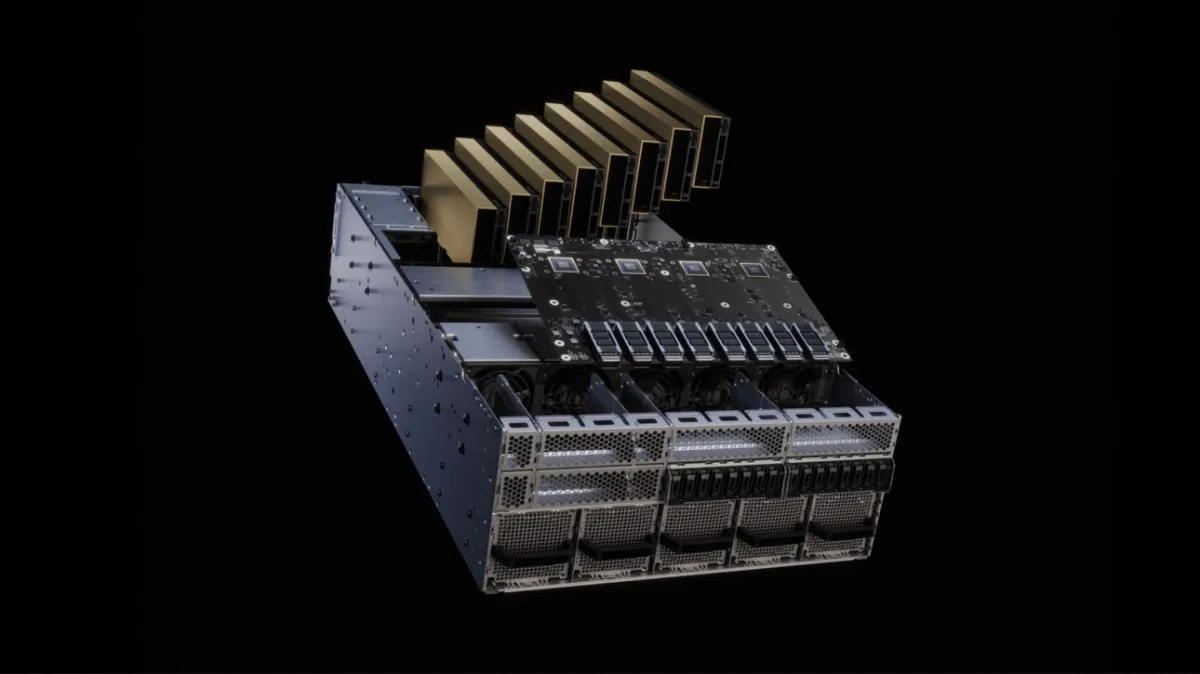
Standardise before we optimise. As Ryanair runs one aircraft, Tandem launches on one node: NVIDIA’s RTX PRO 6000 Blackwell Server Edition, eight to a liquid-cooled server. One set of spares, firmware, tooling and procedures covers the whole fleet, and any workload can move to any site. The chip is the all-rounder of NVIDIA’s current generation, running inference, fine-tuning, training, image and video generation, rendering and simulation, and it puts twice the GPUs into each block as a flagship chip would, for less capital.
rtx pro 6000 blackwell server edition · eight gpus per nodeimage: nvidia
built with
RTX PRO 6000 Blackwell GPUs on Dell servers
Blackwell
NVIDIA’s current architecture, same generation as its flagship chips.
96 GB
GDDR7 memory with ECC, 1.6 TB/s; most production models fit on one card.
24,064
CUDA cores; 5th-gen Tensor Cores with FP4 for ~4 PFLOPS of AI compute.
600 W
Per GPU; 4.8 kW of silicon in an 8-GPU node, liquid-cooled.
€31k
Per GPU, €250k per node ex VAT, against ~€82k for a flagship GPU.
1 to 8
Sold singly, in twos, fours or eights, or as whole nodes.
where the curves meet · three ways to count one node’s power · 8 × rtx pro 6000
PUE 1.1
facility power ÷ IT load · 7.7 ÷ 7.0 · an air-cooled hall runs 1.4 to 1.6
GPU power draw4.8 kW
the chips alone, 8 × 600 W. The unit the market prices; revenue is earned on it.
IT load~7 kW
GPUs plus CPUs, memory, network and local NVMe: the whole node. What is leased; what the cooling loop carries.
Facility power~7.7 kW
IT load plus pumps, heat-recovery loop, UPS and losses. What the meter reads; what sizes the block.
Tandem is pre-trading and pre-revenue. No compute or heat contracts are in place. The figures above are base-case planning assumptions from the Information Memorandum model, not forecasts or a promise of returns.
three tiers
One factory, three scales.
Every Tandem site is an intelligence factory: power in, tokens out. Standardised, liquid-cooled and operated as one network, staged by delivery speed. GPUs leased; the energised facility remains. Tier 1 turns the flywheel first: its revenue and operating evidence finance each larger tier.
Tier 1 · this raise100 kW – 950 kW
No electricity generation required
~80% of energy passed on as heat
12 weeks to deploy
No planning. No rent.
Pools are ideally suited because of heat reuse. Tandem locates on site, draws electricity on its own new connection, and the heat goes back into the pool. Over 350 pools in Ireland spend around €70m a year on heating, mostly gas and oil, ready to convert. Sub-1 MVA connections are treated as de minimis under the current ESB process.
Tier 21 MW – 5 MW
Industrial sites on non-constrained land
Grid + Bloom self-generation
Bloom heat at 350°C for industrial reuse
Clean (non-combustion) and quieter
Industrial sites acquired in unconstrained regions, with grid capacity augmented by Bloom solid-oxide fuel cells: non-combustion, clean and quiet. Bloom also produces heat at 350°C, so the industrial host takes the heat as process heat. Sites enter ESB’s defined large-energy-user pathway with their own firming generation.
Tier 310 MW+
National-scale industrial projects
Own generation, campus-scale heat offtake
Securing the opportunity
National-scale industrial projects: frontier-class clusters on industrial land with self-generated power and industrial or district heat offtake. Tandem is in the process of securing the opportunity; sized for the institutional capital the first two tiers unlock.
designed to the ESB framework
Sub-1 MVA
De minimis under the current connection process, with the site still declared to ESB Networks as a data centre. Tier 1 lives here.
At / above 1 MVA
A defined data-centre pathway: ESB expects a generation or autoproducer route matched to the site’s MIC. Tier 2 is designed to it.
Location-led
Connections favoured where network capacity exists or is planned; applicants signal phasing and demand flexibility. Tiers 2 and 3 site to it.
On-site support
Larger users bring dispatchable generation or storage to firm their demand. Tiers 2 and 3 bring their own power.
The ESB framework, in brief. Tandem has engaged directly with ESB Networks. MW denotes IT load; connection capacity is expressed in MVA (MIC). Management’s summary of published direction, to be evidenced in the data room.
register interest
the eiis space
Not the typical EIIS tax relief offer.
EIIS has mostly meant familiar local sectors. Tandem’s proposal is exposure to the technology stack of the exponential age — a profile rarely available to Irish private investors under the scheme.
the typical eiis offer
the tandem proposal
Hospitality, food and drink, whiskey casks and other familiar trading businesses.
AI compute infrastructure — the physical layer of the exponential technology stack.
Demand bounded by a local market, or a crowded global category like whiskey.
Demand driven by global growth in AI workloads — delivered and monetised locally.
A familiar, well-understood business model.
A new asset class for Irish private investors — compute as the engine, useful heat as the fit.
Relief often at the lower rate, where the company already trades.
Pre-trading, so the investment carries 50% EIIS income-tax relief: the highest rate under the scheme.
Subject to the individual investor conditions and the four-year holding period.
register to receive the IM
A different opportunity profile — not a promise of returns. Early-stage risks apply in full: see the risk note.
the offering€5.5M EIIS after €600K founder capital.
€5.5M of A Ordinary Shares at €3.50, on a €25.0M pre-money valuation (€30.5M post-money). 7,142,858 shares before the raise, 1,571,428 new EIIS shares, 8,714,286 after it; EIIS investors hold ~18.0%. This follows €600K of founder seed capital. The full programme is up to €16.5M over three years, in tranches of no more than €5.5M in any rolling twelve months. Facilities are built at ~€5M per MW (~€1M per 200 kVA); compute and storage hardware is leased from Dell, our hardware partner, so equity buys the energised facility. Tandem Compute Limited is pre-trading; this round funds the start of its trade. Holding period an absolute minimum of four years.
year fourNothing is forced.
There is no set exit date and no set price. After the four-year holding period you remain an owner: keep your shares, sell them if there is a buyer, or accept or decline any buy-back the Company offers.
50% EIIS tax relief. tandemcompute is a qualifying pre-trading company raising investment under EIIS. The scheme operates on a self-certification basis, so there is no general Revenue approval outstanding. Following investment and the required filings, investors receive a Statement of Qualification to support their claim. Investors are responsible for meeting the individual investor conditions.
Capital is at risk. Relief depends on the Company and each investor meeting the statutory conditions. Shares are unlisted with no guaranteed exit, buy-back or dividend.
shareholdingTwo share classes. EIIS investors hold A Ordinary Shares.
Ordinary Shares are the founder and day-one seed class: John Kelly, Simon Kelly, ExTarget (Barry Walsh) and Paddy Connolly, one vote each, held directly. A Ordinary Shares are the EIIS investor class, none in issue at incorporation, to be allotted for this round and held for investors by the nominee Redquartz Trustees Ventures Limited (CRO 670489, Commercial House, Millbank Business Park, Lucan, Dublin, K78 X5W6).
constitution v2.3
a ordinary shares, in plain english
VotingNo general voting rights. Votes only on matters affecting the class, or where the Companies Act requires.
IncomeNo fixed, preferential, cumulative or guaranteed dividend. Any dividend is at the directors’ discretion.
CapitalOn a winding-up or return of capital, A Ordinary Shares rank pari passu with Ordinary Shares. No preference.
Buy-backNo compulsory redemption. The Company may offer to buy back shares after the holding period; each holder decides whether to accept.
TranchesMay be issued in tranches with differing allotment and redemption terms.
What they are notNot preference shares, not convertibles, and not Ordinary Shares with fewer votes. A separate class with the rights above.
Summary of the final-draft constitution (v2.3), subject to legal and tax review and not for execution or filing. Full terms are in the Information Memorandum and subscription documents.
the opportunity
The largest capital build in history is under way, and it is compute.Do you want to own part of it?
Every generation of infrastructure has had its owners: rail, telecoms, the grid. Compute is this generation’s. Ireland has hosted every wave of the technology economy and largely rented it; this time there is a proposed way for Irish investors to own part of one.
register interestDon’t just be a consumer. Understand the opportunity to become an owner.
team
The people behind tandem.
Founders Simon and John Kelly: thirty years of building, with the lessons of two cycles structured into Tandem, and €600K of founder capital already raised.
redquartz track record
3m+sq ft of commercial space
5,000+homes delivered
6,000+hotel rooms
€3bn+combined deal value
Commercial deals included lettings and developments for US multinationals operating in Ireland, among them Amazon and Oracle.
1990s – 2007
Redquartz. Built alongside his father Paddy Kelly, one of Ireland’s best-known developers: over 3 million sq ft of commercial space, 5,000+ homes and 6,000+ hotel rooms, deals worth a combined €3 billion+. Then the Global Financial Crisis arrived, and everything the model was built on stopped working at once.
2019 – present
RQTwo. Founded by Simon after a decade of rebuilding from first principles: an active asset manager acquiring undervalued commercial buildings below replacement cost, raising €70M+ in equity. When WFH structurally impaired the secondary office market, the lesson of concentration was learned a second time.
Quinn’s
Direct EIIS, proven. A €3.5M direct EIIS raise unlocked for the Quinn’s pub project, now fully open and operational: the structure, investor base and compliance machinery this round runs on.
Now
tandemcompute. Founders. The answer to both cycles: infrastructure that produces trading income from day one, in the fastest-growing demand market in the world.
Simon Kelly
co-founder
Commercial and external development; host, investor and partner relationships. Co-led Redquartz; founder of RQTwo, €70M+ of equity raised.
John Kelly
co-founder
Revenue, operations, host development and commercial strategy. Part of the Redquartz group’s track record across Irish development, hospitality and investment.
wider team
Barry Walsh
Co-founder. Advisory; gym and hospitality site development.
Paddy Connolly
Co-founder. Advisory; industrial site pipeline development.
Paddy Kelly
Chairman.
James Kelly
AI & sales. Building Tandem’s model-serving capability and the direct customer channel.
AI software specialists, Ukraine. The Disrupt engineering team builds Tandem’s fleet-management software and AI-services layer. Retained under contract; IP assigned to Tandem.
Non-binding, and it costs nothing to be on the list. The IM arrives by email within one working day.
risk notedraft — pending adviser approval
Any future investment would involve early-stage, unquoted shares and could result in the loss of all capital invested. There is no guaranteed market, exit or redemption. EIIS relief depends on each investor meeting the individual investor conditions. Full risks and terms will be set out in the final documentation. Independent financial, legal and tax advice should be obtained.
Expression of interest only — non-binding. To invest, apply through the shareholder application page. By submitting, you ask Tandem Compute Ltd to manage this registration and email you the Information Memorandum. Privacy Notice