Want cheaper heat
for your building?
We build and pay for the pod. You get the heat it makes. No capital cost, no catch.
A liquid-cooled compute pod on your site does useful AI work, and the warm water it produces is metered and piped into your heating system. We typically seek our own dedicated electricity connection and MPRN, so your existing supply stays yours.
- Pools and leisure centres with year-round heat demand
- Hotels and hospitality with hot-water and space-heating load
- Industrial heat users and powered land
From a phone call to warm water.
You provide the ground and a use for the heat. tandemcompute does the rest, and carries the cost.
Viability check
We assess your site for electrical headroom and for heat demand: how much warm water you can use, and when. Together those set the right pod size. We then apply for a dedicated grid connection and our own MPRN; your existing supply is untouched.
What you get: a written view on whether the site works, what size pod it would carry, and the heat it would return. No cost, no commitment.
Design, build and operate
A liquid-cooled compute pod, from 200 kVA up, sited in a car park or plant room. We own it, run it, insure it and answer for it. Sound level of normal building plant.
What you get: the capital cost, the grid application, the install and the maintenance are ours. You commit space and access.
Heat returned
Warm water is metered and piped to your pool, hot-water system or process line; cool water returns. It displaces gas or electric heating, so the first thing you notice is a smaller energy bill.
What you get: lower heating costs, rent or a site licence on top, and a metered record of every kilowatt-hour returned.
The heat story. Why the host wants us there.
Gas and land are intertwined. Burned in a boiler, gas makes heat and nothing else. Run through Tandem's CHP, the same gas first makes electricity for AI compute, and almost all of it still arrives at the building as heat. That is why a gas-heated pool wants Tandem on site.
Of 440 kW in, about 355 kW reaches the building as useful heat, after 225 kW has run AI compute on the way.
One heat source, used all the way downEngine exhaust
Recovered to ~120°C by the standard exchanger, and to ~85°C with an optional second one.
CHP heating water
Supplied at 90°C, returned at 70°C (40–70°C permitted): space heating, showers, air-handling coils.
Compute loop
Pre-heats the hot-water supply; underfloor heating.
Pool water
The largest steady heat demand in the building, all year.
Most of its heat from Tandem, metered and free, cutting its gas bill. Its boilers and a base gas supply stay in place.
Space inside the building, rent-free, and the use of most of its existing gas connection.
A site with no land cost and no new gas connection, and electricity for its compute from that gas.
At the pool. Two connections, one pod.
Every gas-heated pool and building is already connected to the gas network. Tandem uses that connection as well as its own new electricity supply. A combined heat and power (CHP) unit on the host's existing gas connection generates more electricity for the compute, and the host receives heat from both, for its pool, space heating and hot water.
How a site is energisedESB · new MPRN
Tandem's own electricity connection, sub-1 MVA, separate from the host's supply.
GPU compute
Liquid-cooled nodes, sold through the revenue channels.
Compute heat
~80% of electrical energy recovered as heat for the host.
GNI · existing gas connection
The host's connection. Tandem takes gas after the meter and pays for it.
CHP unit
Generates electricity for the compute; its heat is recovered, not rejected.
CHP heat
Into the pool, space heating and hot water, alongside the compute heat.
Host base supply
A base volume of gas stays reserved for the pool's own boilers.
Connection stays open
If Tandem stops using gas, the pool takes the full connection back.
Boilers retained
For peaks and resilience. The host never loses its heat source.
More heat than it uses today.
Heat from two sources, metered and free, with its own boilers and base gas supply untouched. Tandem can draw more gas than the pool burns today, within the connection's capacity, and returns the heat.
Throughput kept, decarbonisation paid for.
GNI has directed Tandem down this route. It keeps gas flowing on connections that would otherwise decline, and Tandem can pay for biomethane, giving renewable gas a committed buyer.
More compute per kW of new connection.
Part of each site's power is generated on site, so every new ESB connection carries more compute. Self-generation to firm demand is the direction ESB already asks of larger loads.
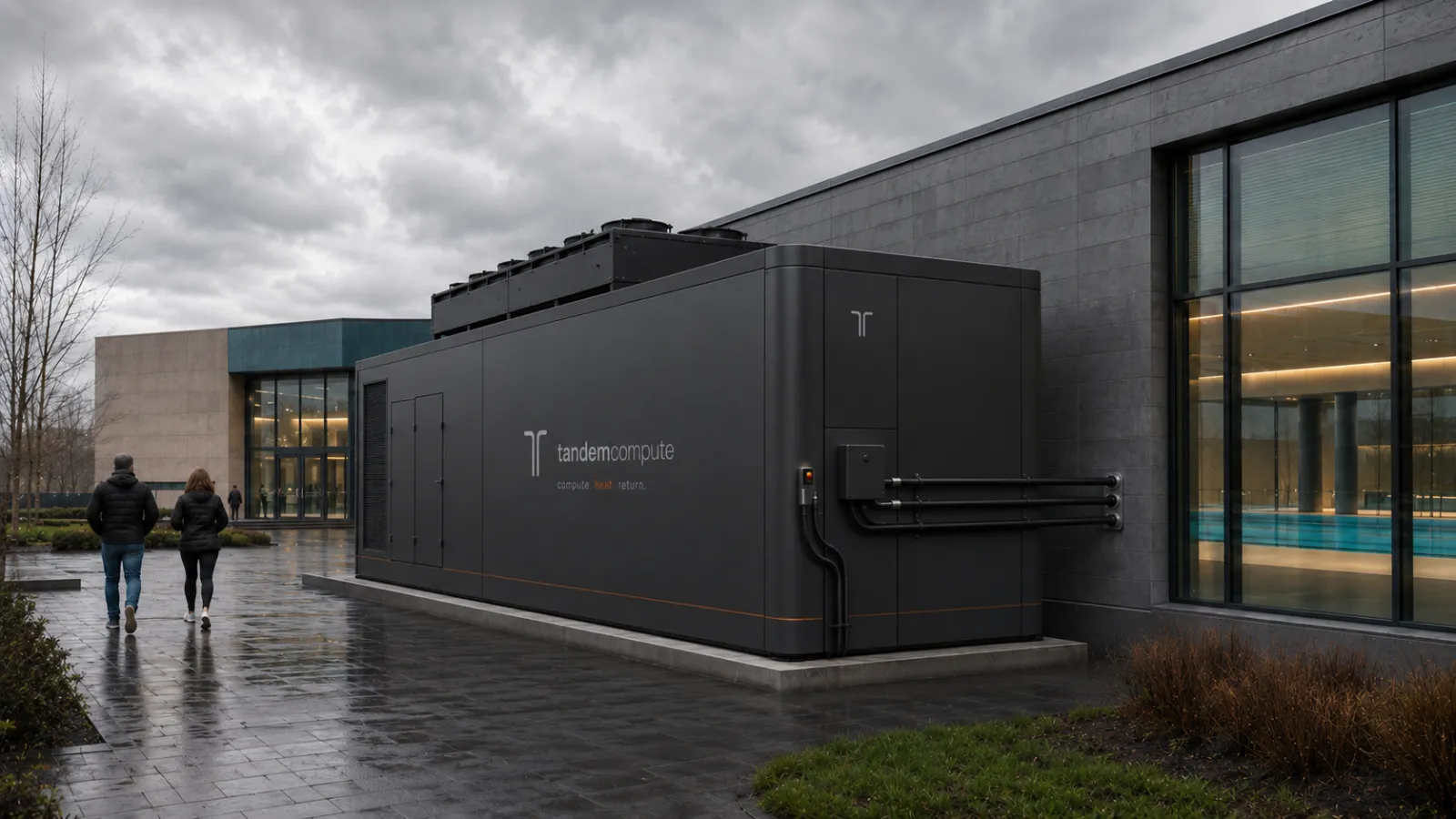
Two ways to host.
Both are liquid-cooled, both connect to your heating system, both run at the sound level of normal building plant.
Inside your facility
Racks in an existing plant room or store, from about 20 m². Shortest pipe run to your heating plant; nothing visible from outside.
A container pod on site
A sealed pod the size of a shipping container on a car park, yard or service area. Delivered complete, connected to your building by insulated pipework. Scales by adding pods.
From swimming pools to powered land.
Heat users
- Swimming pools
- Leisure centres
- Hotels
- Hospitals
- Healthcare facilities
- Sites with large thermal demand
Land and industry
- Industrial sites
- Manufacturing
- Warehouses
- Quarries
- Powered land
- Energy sites
Institutions and property
- Universities
- Commercial properties
We’re looking for sites across Ireland. If you run a pool, a hotel, a factory or powered land, we’d like to talk.
Your existing electrical connection remains yours.
tandemcompute assesses a separate electrical connection for its compute infrastructure and typically operates through its own dedicated MPRN. The compute load is not intended to sit behind the host’s existing meter. This is subject to network availability and connection feasibility at the site.